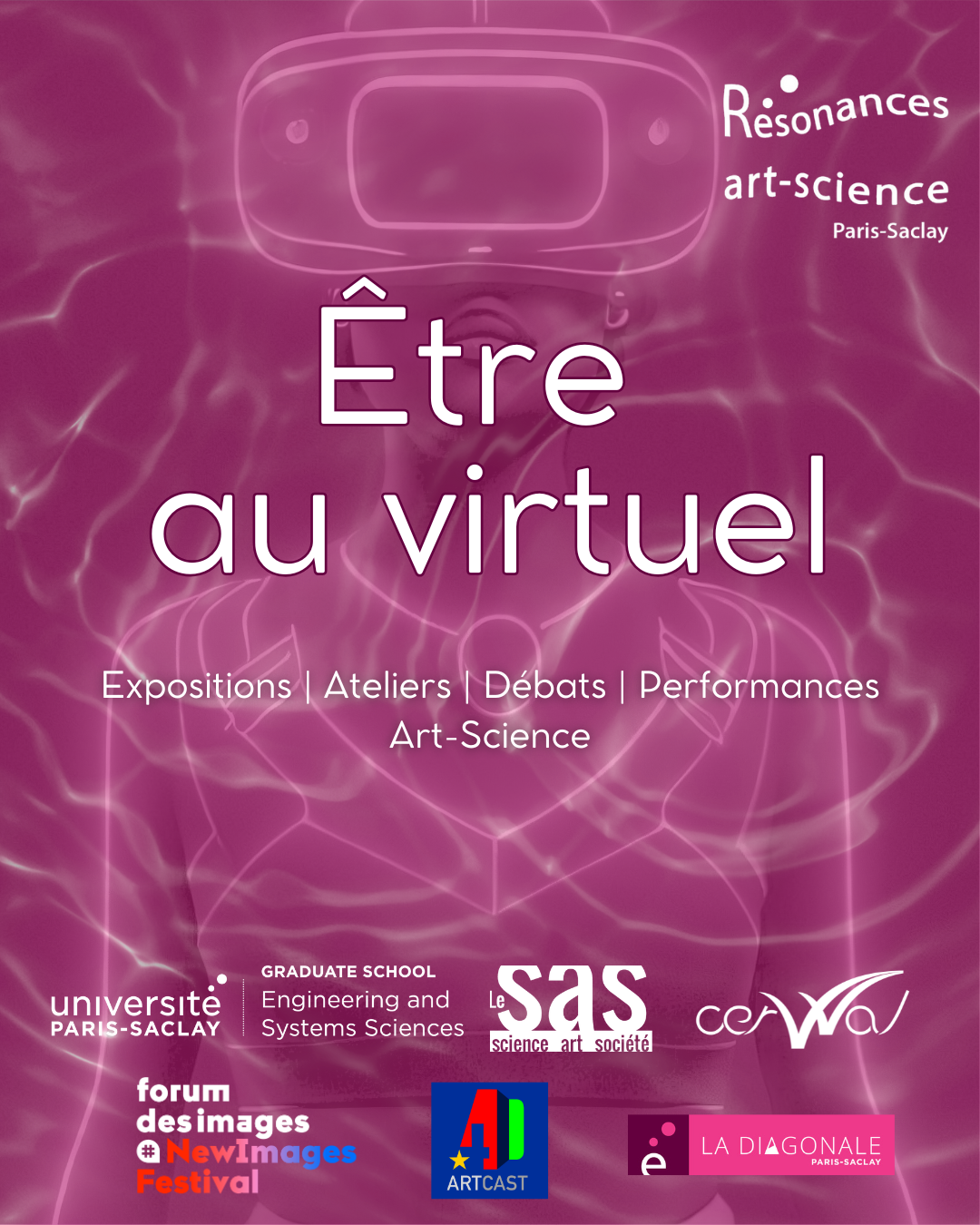
Being at the virtual| NewImages Festival 2025
As part of the Résonances art-science project, the second resonance axis explores the multiple dimensions of the virtual through a collaboration with the Forum des images. On this occasion, several days of meetings, presentations, round tables, and art-science workshops will be organized as part of the NewImages Festival, a leading event in Europe for digital and immersive arts.
The program associated with Being at the virtual promises to be rich and will span three days – April 9, 10, and 11 – bringing together numerous artists, scientists, as well as other stakeholders working in the virtual realm. Find below the detailed program and an introduction to the speakers who will enrich these discussions.
Wednesday 9 April 2025
Petit Amphi
10:00-10:30
Defining immersion and immersive technologies - Davide Spallazzo | Marco Denni - Department of Design, Politecnico, Milano, Italia
This presentation reports the investigation conducted within the European project Artcast4D by Politecnico di Milano, Design Department. The goal of the research is to define theoretical concepts behind the immersive installations and experience for the Art and Culture realms.
It starts with a systematic literature review that rigorously defines immersion and its constitutive elements. Spanning nearly a decade of research, this analysis identifies six pivotal keys of immersion: Presence, Cognitive and Emotional Engagement, Sensory Involvement, Embodiment, and Isolation. These elements form the foundation of an immersive experience, highlighting the essential role of technology in creating an engaging sensory and emotional journey for users. By examining the intricate interplay between technological mediation and user experience, the work presented provides a nuanced understanding of immersion's core components.
10:30- 11:30
Opening up immersion: creating alternative realities in public spaces - Ikse Maître | Tim Schneider - Le sas, Université Paris-Saclay, Bures-sur-Yvette, France
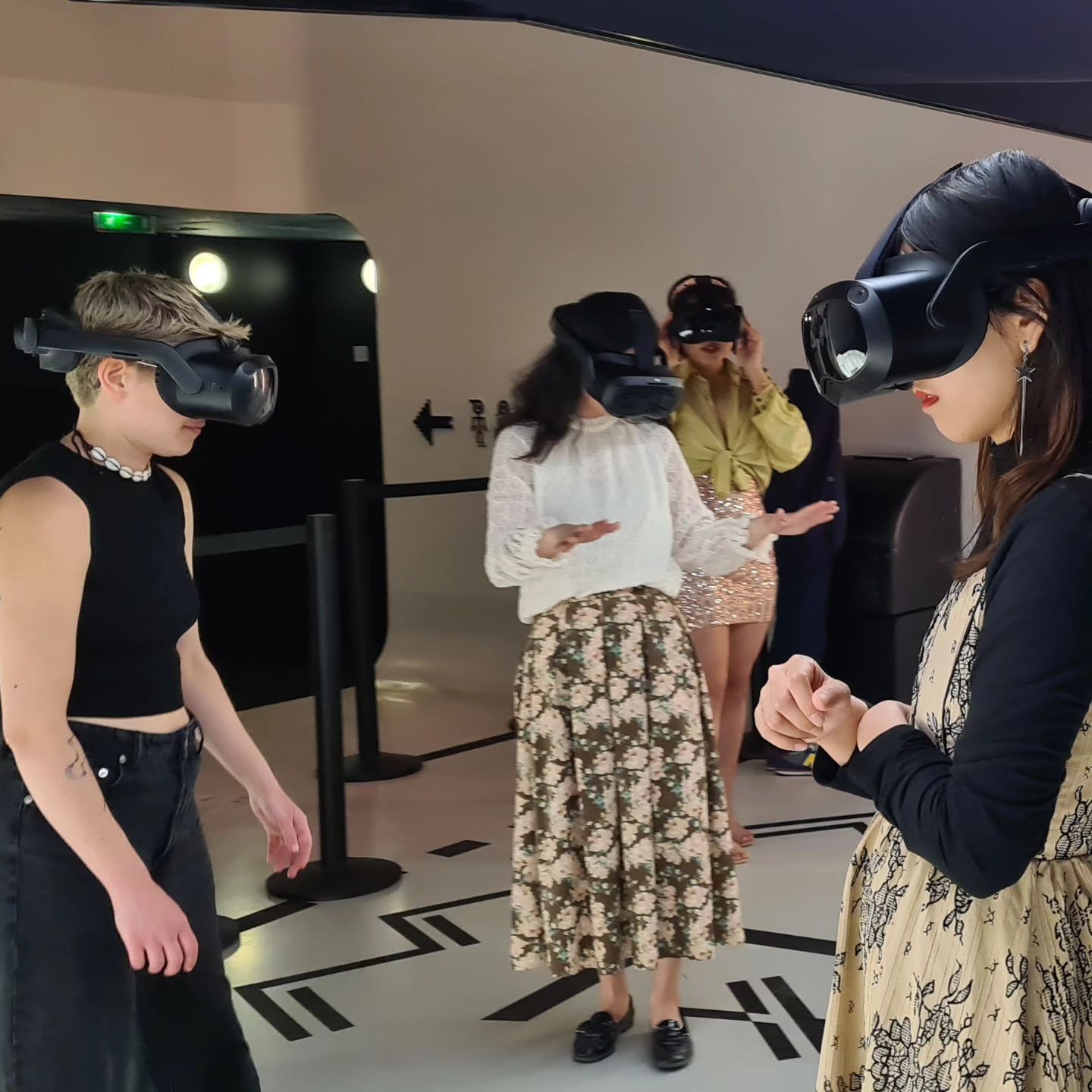
Oftentimes, technology-based immersive experiences are developed for dedicated equipment where the environment is fully controlled allowing visual and sound stimuli to be uniquely ruled by the artistic proposal. Despite the technology on offer, the implementation of immersive settings in contingent open spaces remains a particularly challenging task. Here we investigate some of the requirements, especially interactivity, through four interactive installations spanning from VR (Memory Box), 360° (The L∞p), wall and ground projection (Ariadne’s fibres), and spherical projection (The Eye of the Sun). With advanced tracking of passers-by, they offer unique experimental platforms for field research on what may catch attention, trigger immersion and who may be immersed.
11:30- 12:00
Opportunities and Challenges of Immersive Technology in the Creative and Cultural Sectors - Maria Paola Pofi - Culturalink, Valencia, Spain
This session delves into the evolving role of immersive technologies in the cultural and creative industries. It presents the findings of a study conducted as part of Artcast4D, a Horizon Europe-funded project aimed at exploring the factors influencing the use of immersive technologies by cultural organizations and individuals. Through a mixed-methods research approach engaging diverse European stakeholders—including artists, industry experts, and the general public—the study maps the digital art ecosystem, identifying both the opportunities and challenges posed by the introduction of immersive and interactive tools within cultural and artistic practices. Additionally, it offers strategic insights and actionable recommendations for the broader and more sustainable adoption of immersive technologies in the sector.
S100
17:30- 18:30
Panel: Hybrid Worlds: XR at the Crossroads of Scientific Research and Artistic Creation - Matthieu Courgeon | Léa Dedola | Yasmeen Hiti | Rémi Sagot-Duvauroux | moderation Ikse Maître
This round table explores the intersection of art and science through the transformative power of XR innovation, revealing how immersive technologies become catalysts for both creative and scientific expression. By blending data, storytelling, and interactivity, XR fosters new dialogues between disciplines — from rendering complex scientific phenomena into engaging visual narratives to crafting poetic, data-driven experiences. The discussion will highlight how collaborations between artists and scientists push the boundaries of their fields, resulting in immersive works that challenge perceptions, stir emotions, and offer profound new ways to understand our world.
S Petit Amphi
10:00- 13:00
Unleashing 3D real-time creativity with AAASeed - Mâa Berriet (Artcast4D)
Workshop 1/2: AAASeed Concept and Interface
AAASeed has been used for 25 years by Mâa Berriet and his teams to produce massive immersive environments and a variety of different real-time applications (AAASeed.org). Today, as part of the ArtCast4d European project (artcast4d.eu), AAASeed is on its way to becoming the only free and open-source software (MIT license) in its category. This 3-hour hands-on workshop will help beginners master the interface, introduce the basic concepts, allow you to conduct your first experiments by combining basic blocks, and let you play with real-time images, videos, and processes.
Thursday 10 April 2025
S50 | S20/30
10:00- 13:00
Workshop on real-time programming on Shader and OpenGL - Mathieu Courgeon (Cervval)
The workshop will provide hands-on experience with an interactive GPU-based physics simulation renderer derived from the one used in the artistic installation MemoryBox VR. Designed for interactive virtual reality and coded in GLSL, participants will have the freedom to evolve the simulation, synchronise it with images, video and sound, and create their own unique experience. An immersive experience with a cloud of bubbles - autonomous, interactive and with a unique personality for each artwork and creator. The workshop aims to bridge the gap between low-level GPU coding and lived experience. Guidance will be provided to facilitate immersion in the code while allowing maximum creative freedom.
Friday 11 April 2025
S50 | S20/30
10:00- 13:00
Unleashing 3D real-time development with AAASeed - Mâa Berriet (Artcast4D)
Workshop 2/2: AAASeed Coding Workflows
AAASeed has been used for 25 years by Mâa and his teams to produce massive immersive environments and a variety of different real-time applications (AAASeed.org). Today, as part of the ArtCast4d European project (artcast4d.eu), AAASeed is on its way to becoming the only free and open-source software (MIT license) in its category.
This 3-hour hands-on workshop is a continuation of the first workshop (AAASeed Concept and Interface) and is designed for people who want to write graphic or real-time applications or at least experiment with shaders. It will cover Lua scripting for drawing and handling basic interface elements (buttons, sliders, selectors, etc.), how to write and modify shaders while they are running, and provide you with the tools to manipulate existing blocks and add new ones. Knowledge of Lua and/or GLSL will be helpful but is not mandatory.
Intervenants – Modérateurs – Présentateurs

Davide Spallazzo
Associate professor at the Department of Design at the Politecnico di Milano. Trained in industrial design at Polimi, he specialized in interaction design through his PhD, awarded by the same institution. His main research interest is the human-centred approach to digital innovation and meaning-making, spanning diverse areas, including heritage valorization, gaming, and education. Currently, he serves as Programme Coordinator of the BSc in Interaction Design and the MSc in Digital & Interaction Design at the School of Design of Politecnico di Milano.

Marco Denni
PhD student, he commenced his exploration of virtual reality technology within the VR laboratories of the institution, after taking both bachelor's and master's degrees in the Design department at Politecnico di Milano. His research is dedicated to the observation and analysis of the application of immersive and advanced technologies within the artistic and cultural domain. He has been actively involved in the European research project ARTCAST 4D on the definition of immersion and immersive technologies concept.

Ikse Maître
Ikse|Xavier Maître is a physicist and CNRS researcher at the Multimodal Biomedical Imaging Laboratory in Paris-Saclay (BioMaps, CEA, CNRS, Inserm, Université Paris-Saclay). His early research focused on the foundations of quantum mechanics and the mechanisms of quantum entanglement and decoherence. Today, he combines atomic physics and medical physics to develop new tools for exploring the human body. He coordinates the European innovation project V|LF-Spiro3D on 3D magnetic resonance spirometry.
Ikse Maître initiated the science-art-society group Le sas where he conducts art-science research based on unconstrained human-machine interaction. He develops art-science experiences and relies on reality shifts to test our relationships with the world and engage with the public. He coordinates the work package on immersive technologies for the European cultural heritage project Artcast4D and is investigating the keys to immersion in public space at the Forum des Images on the installation Ariadne’s Fibres.

Tim Schneider
Tim Schneider was trained in high-energy physics and holds a PhD in radiotherapy and hadrontherapy. Having transitioned into the field of art-science, his research at Université Paris-Saclay now focuses on immersive installations in open spaces and on exploring new approaches to tracking systems for people and movement. Additionally, he is a member of the collective Le sas, where he primarily works on creating and developing interactive digital art pieces and experiences.
Léa Dedola
Léa Dedola is an artist and researcher at Université Lumière Lyon 2, exploring the intersection of emotions and technology. She holds a background in immersive & interactive media and has developed works integrating biosensors to create emotionally responsive environments.
In 2020, she created Quand le cœur se serre (When the heart tightens), a narrative VR experience using heart rate sensors to translate physiological reactions into immersive storytelling. Currently, she works with the Cie Fheel Concepts, on VIBH?O, a hybrid circus performance that captures emotions through biometric data, shaping the visual and sonic experience of a large audience in real time. She is also co-creator of Imaginary Encounters (2025), an artistic-research project investigating digital sexualities and the perception of intimacy in collective immersive environments.
Beyond her artistic practice, Léa works on innovative interfaces for emotional interaction, including Emotouch, a mainstream sensor-based controller designed for artists and scenographers.

Maria Paola Pofi
Maria Paola Pofi is a researcher at Culturalink, a Spain-based consultancy specializing in research, analysis, and advisory for the cultural and creative sectors. She is currently contributing to multiple Horizon Europe and Erasmus+ projects connected to culture, technology, and innovation. Maria Paola holds a PhD in Culture, Media, and Creative Industries from King’s College London and has lectured on media and cultural studies at King’s College London and the London School of Economics and Political Science (UK). Her research spans digital media culture; cultural production and consumption; media practices and discourses; gender, feminism, and media; and contemporary culture, diversity, and inequality.
Mâa Berriet
Emmanuel Mâa Berriet is a mechatronic engineer and a digital pioneer, passionate about coding and 3D since the 1980s. Born in 1961 in Algiers, he began exploring 3D on Silicon Graphic workstations and early on envisioned innovative, low-cost solutions, leading to the creation of AAASeed—a versatile software for real-time immersive creation. As a digital artist, he has transformed technologies such as the Kinect into interactive experiences, merging art, technology, and science to push the boundaries between the real and the virtual.

Matthieu Courgeon
Matthieu holds a PhD in Computer Science from the University of Paris-Sud in real-time interactive 3D computing. After defending his doctoral thesis in 2011 on animated conversational agents, he joined the European Center for Virtual Reality in 2013, specializing in immersive collaborative interaction.
Matthieu has also contributed to various digital installation projects aimed at scientific outreach and dissemination, particularly exhibited at the Cité des Sciences et de l'Industrie in Paris and the Musée des Arts et Métiers in Paris
.
In 2018, he joined Cervval as a research engineer specializing in collaborative virtual reality. He is the designer of the XR 3D engine for the DigiTwin technology platform. Today, he is a project manager in this field and leads R&D efforts on XR and learning technologies
.
Yasmeen Hiti
Yasmeen Hitti is a PhD candidate at McGill University and Mila, working at the intersection of plant sciences, robotics, and artificial intelligence. Her research focuses on the interface between plant behavior and technology, drawing on the electrical signals of plants and simulations. As a multidisciplinary researcher, she has had the opportunity to collaborate on projects ranging from gender equality to materials science, including the development of IoT sensors and the interfacing between plants and robots. She is a fervent advocate of open source hardware and works to lower the barriers to creating ethical AI systems for both humans and non-humans.
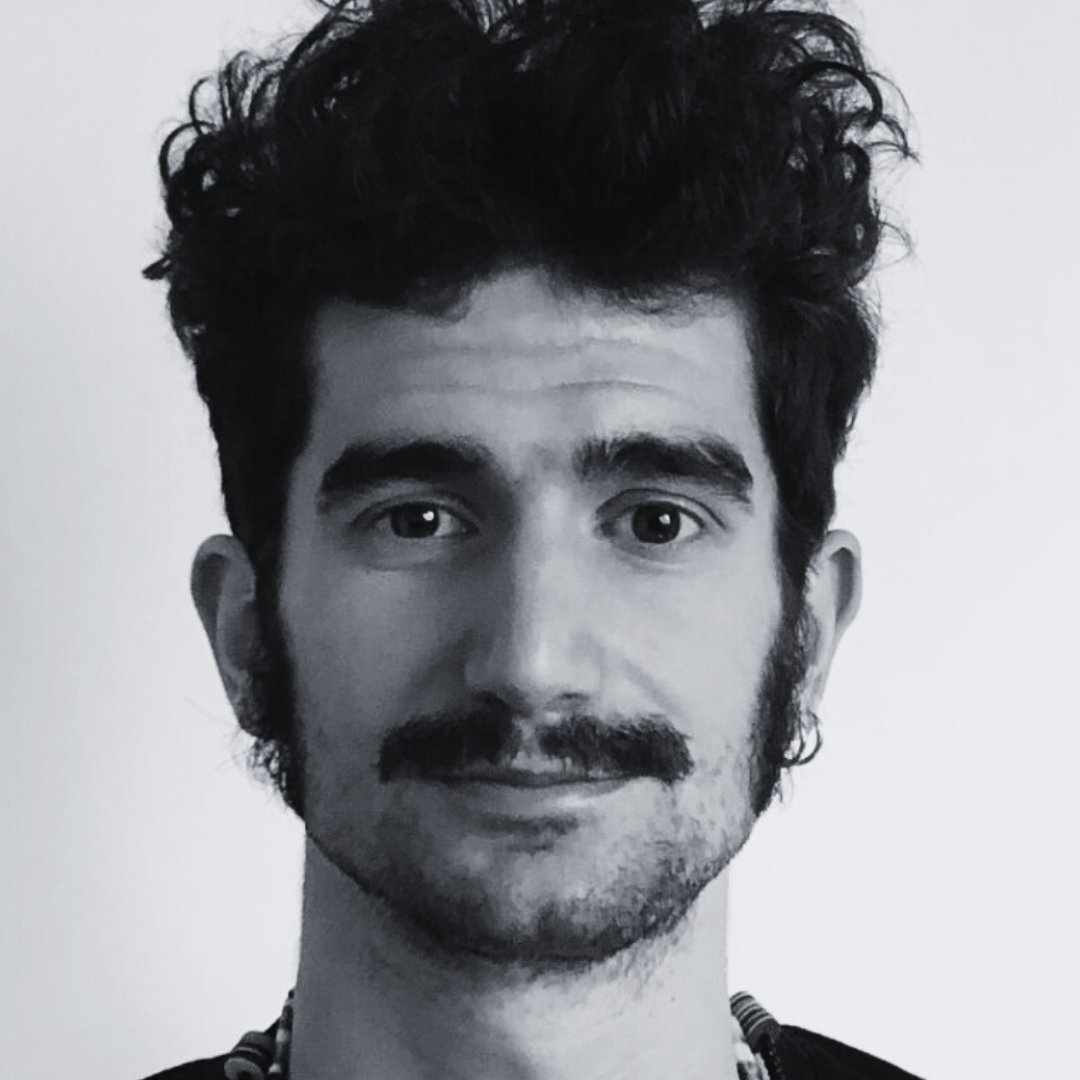
Rémi Sagot-Duvauroux
Rémi Sagot-Duvauroux is a film editor and virtual reality experience designer. After beginning in 2013 on a variety of projects – ranging from animated films to documentaries – he specialized in immersive Research-Creation within the Spatial Media group of EnsadLab. Since 2020, he has been pursuing a PhD titled “Le Corps-Monteur” and is distinguished by his creation of innovative interactive installations. Additionally, he shares his expertise by teaching virtual reality creation at several Parisian institutions.