
1 BioMaps, Université Paris-Saclay, CEA, CNRS, Inserm · 2 LISN, Université Paris-Saclay, CNRS · 3 Forum des images · 4 Cervval · 5 La métonymie, Le sas
Paper published in IFAC-PapersOnLine 59(11), pp. 252–257, 2025 (doi.org/10.1016/j.ifacol.2025.09.557), presented at the 2nd IFAC Workshop on Control of Complex Systems (COSY 2025), Gif-sur-Yvette, 30 June – 2 July 2025. Summary of the paper; the full text can be downloaded at the bottom of the page.
Ariadne’s Fibres at the Forum des Halles, 21 January 2025
Immersive experiences and art installations are becoming ever more popular. While they are usually developed using specialized technology (such as head-mounted displays) or dedicated, fully controlled environments (often black rooms with video projections on the walls and floor), the implementation of immersive installations in open, public spaces (such as city squares or shopping malls) remains a particularly challenging and interesting task: how to deal with unfavourable conditions on site (noise, stray light, etc.) and how to effectively engage passers-by? In this paper, we present the generative evolutive interactive installation Ariadne’s Fibres, located in one of the busiest shopping malls in Paris, France. With advanced tracking of passers-by, it provides a unique experimental platform for field research on what may catch attention and trigger immersion. In this context, Ariadne’s Fibres is part of an ongoing study investigating, through trajectory analysis and questionnaires, the key parameters for immersion in open, public spaces.
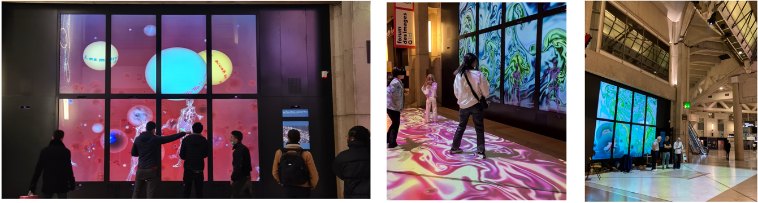
Figure 1. Ariadne’s Fibres, a living mirror created by Ikse Maître in 2018 with music by Vincent Hulot and developments by Matthieu Courgeon (Cervval): users interacting with their avatars and the video bubbles that they generate when moving. © 2024 La métonymie.
A permanent digital artwork commissioned by the Forum des images and the City of Paris, Ariadne’s Fibres occupies the shopfront of the Forum des images, freely accessible every day from 8 am to midnight. It faces a busy passageway of the Forum des Halles, between the world’s leading cinema in terms of admissions and Châtelet-les-Halles, Europe’s biggest underground station. The mirror connects inside and outside in several ways: outdoor weather drives the installation’s behaviour, passers-by discover the insides of their own bodies, and film clips programmed at the Forum des images are shown in the passageway.
The setup combines a 7.7 × 4.5 m video wall, a 7.7 × 4.8 m floor projection and four ambient loudspeakers (Figure 2). Eleven Kinect cameras and a wide-angle ceiling camera detect passers-by; two workstations compute interaction, graphics and sound.
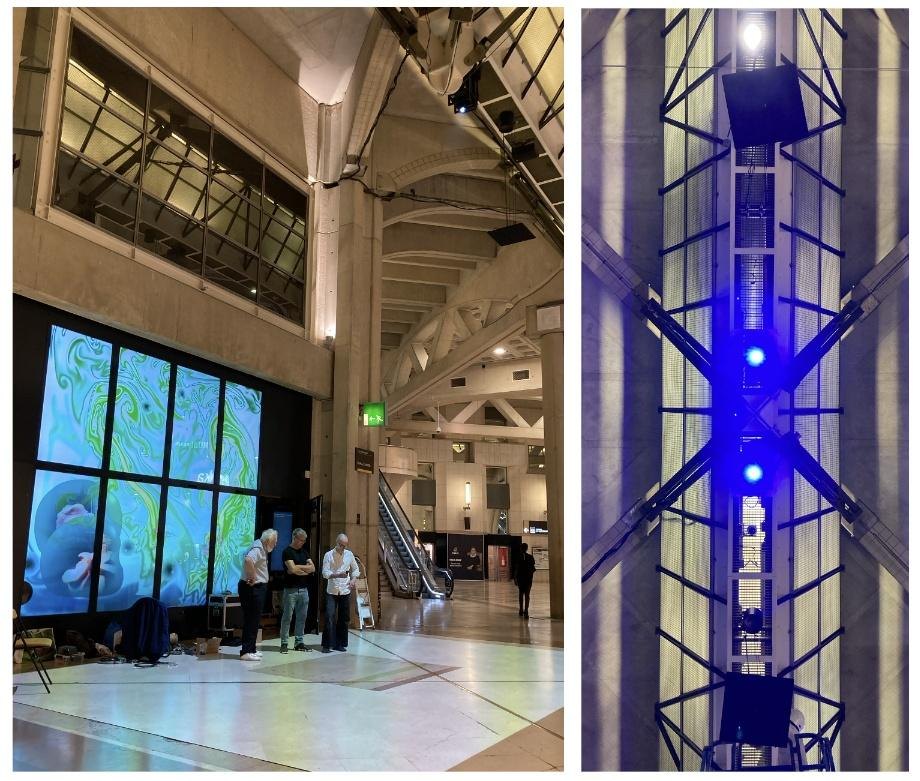
Figure 2. Technical setup. Left: the 4 × 2 video wall surrounded by the 11 Kinect cameras and the interaction zone defined by the floor projection. Right: the two ceiling-mounted video projectors, the wide-angle top-view security camera and two ultrasonic directional loudspeakers.
In its idle state, the image layers a bright background of changing colour, a real-time fluid simulation and large 3D bubbles showing the Forum des images programme, over one of twelve music tracks composed for the work. When passers-by enter the interaction zone, avatars appear on the wall and the floor as their side and top reflections. Two avatar families were designed for the study: bodies made of anatomical fibre systems – nerves, blood and lymphatic vessels, muscles – whose appearance follows the weather and the seasons, and anthropomorphized animal bodies. Each passer-by also adds a heat source to the fluid simulation, which swirls into vortices. The study compares several scenarios: wall only or wall and floor, fibre or animal avatars (Figure 3).
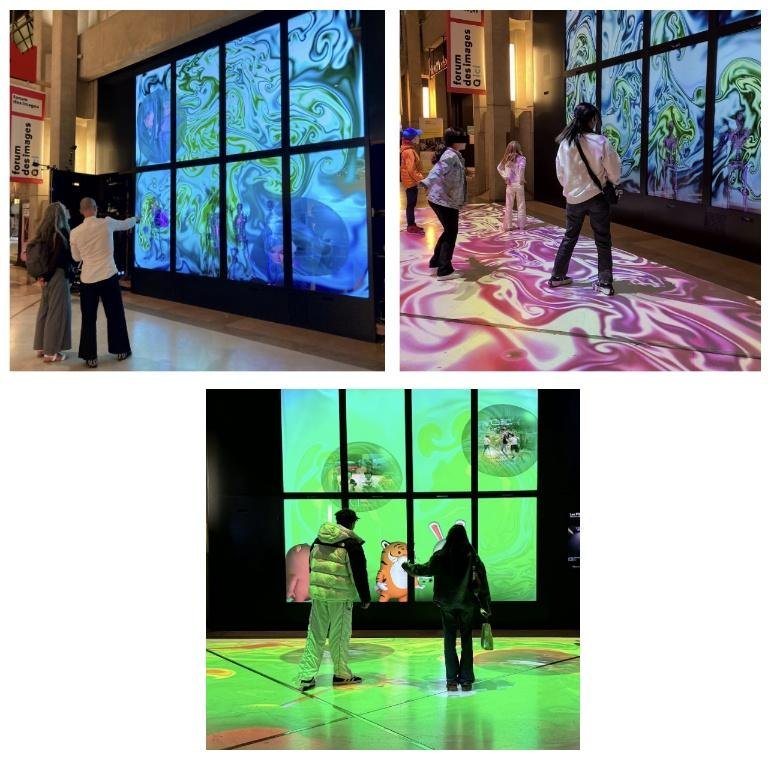
Figure 3. Three interaction scenarios. Top left: screen wall only, fibrous avatars. Top right: screen wall and floor projection, fibrous avatars. Bottom: screen wall and floor projection, animal avatars.
Fitting the work into the shopfront required a bespoke cabinet housing the eight screens, thirteen computers, a router and power supplies; the heat must escape through ventilation slits that also let dust in, calling for regular maintenance. On the control side, the challenges lie in the size of the interaction zone (about 8 × 6 m), the lighting (neighbouring shops, moving projection onto passers-by) and real-time requirements (under 40 ms latency). The eleven Kinect cameras, with a range of 0.5 to 5 m, are registered to a single virtual and physical frame through a VR calibration application. But distant passers-by are poorly detected, and up to 20 or 30 people may pass at once, hiding one another: a wide-angle camera installed 9 m above the floor therefore provides a top view whose tracking is merged in real time with the Kinect data.
A detection model derived from YOLOv8 nano, retrained on 1,432 hand-labelled camera images, detects people seen from above in real time despite the floor projection on their bodies (precision 0.97, recall 0.97, mAP50 0.98). Seen from above, nobody hides anybody else. A tracking algorithm then links detections from frame to frame by proximity, with filters against double detections and a central tracking zone that avoids recounting at the image edges (Figure 4). In real time, it overestimates the number of passers-by by 10 to 30% – small avatar discontinuities that are acceptable in practice.
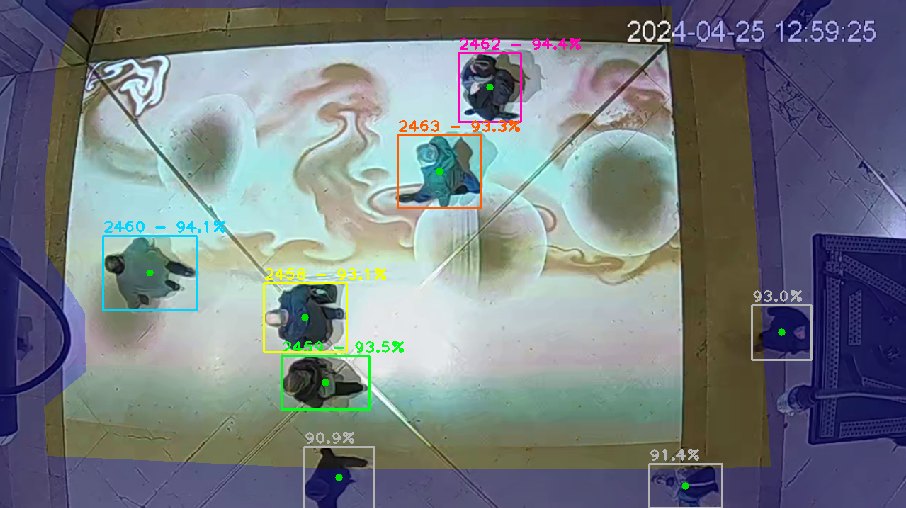
Figure 4. An analysed top-view image: each detected person is framed (in colour if tracked, in grey otherwise) with its tracking ID and detection confidence. The blue border marks the non-tracking zone.
The work’s location and top-view tracking make it an ideal platform for studying immersion in public space, as part of the European project Artcast4D. The study has two parts. The first analyses trajectories: after filtering, the counting error falls to 1–3%, and each anonymous track is classified – passing, interaction, stopping or other – according to its length, duration, speed variations and linearity (Figure 5). The share of each class makes it possible to compare scenarios and see what stimulates or inhibits passers-by’s engagement. The second part measures the lived experience with the SP-IE questionnaire (Khenak et al., 2019): spatial presence, affordance, enjoyment, perceived realism, attention, cybersickness and social presence. The same measures, already collected for a VR experience, a 360-degree projection and a touch-sensitive spherical sculpture, widen the comparison to the device, the interaction mode and the exhibition venue.
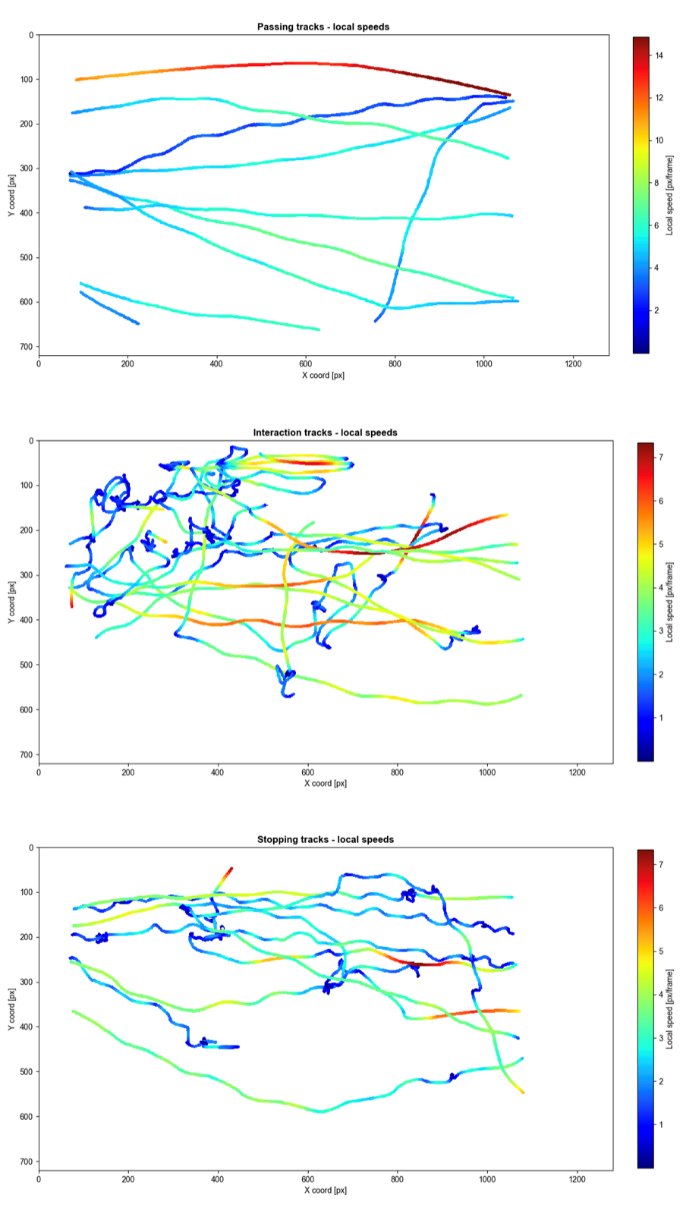
Figure 5. Instantaneous speed along ten selected tracks for each class: passing (top), interaction (centre) and stopping (bottom), in top-view image coordinates.
Located in one of the busiest shopping malls in Paris, Ariadne’s Fibres faces specific technical challenges: covering a large interaction area, tracking many people simultaneously and mitigating occlusions. A composite tracking system, eleven Kinect cameras and machine-learning detection on the top view, addresses them. The installation thus becomes a unique platform for field research on immersion in public space, where the Artcast4D study combines automated trajectory classification and a questionnaire.
Ariadne’s Fibres was commissioned by the Forum des images and the City of Paris. It was included in a comparative field study carried out in the context of the project Artcast4D, which received funding from the European Union’s Horizon Europe research and innovation programme (grant agreement No 101061163).

Paper (pdf)
